The practical layer
Small habits that steady a week across two homes
None of these habits is clever. Each one removes a recurring irritation, and together they are the difference between a week that runs and a week that is negotiated.
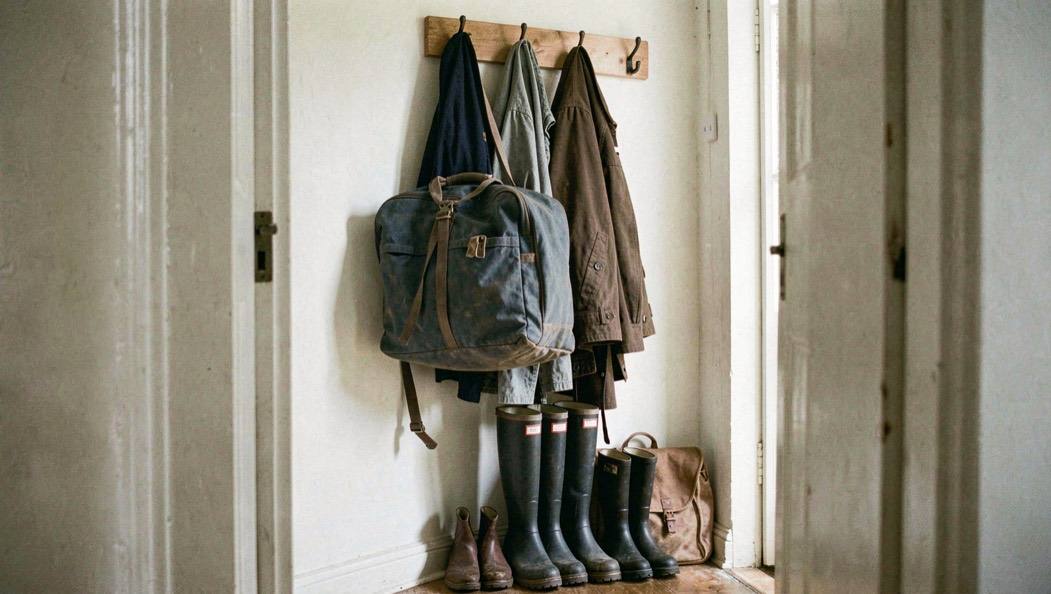
01 The bag is packed the night before
Almost every difficult morning in a shared family starts as a bag packed in a hurry. Packing the night before moves the decision from a rushed twenty minutes to a calm five, and it lets a child do some of it themselves, which matters more as they get older.
Keep a short written list inside the bag for anyone under about eleven. Not a chart on the wall, which becomes invisible after a fortnight, but a card in the front pocket: reading book, PE kit, water bottle, charger, the thing for Thursday. The list changes twice a year and saves an argument a week.
The bag also travels better if it is one bag. Two bags and a carrier means something gets left, and the thing left behind is always the item needed first.
02 Keep duplicates of the cheap things
A toothbrush, a charger, a hairbrush, pyjamas, a set of underwear, a jumper and a pair of wellingtons in each home cost very little and remove a category of problem entirely. The expensive items travel. The cheap ones live in both places.
The same logic applies to the school run. A spare set of PE kit in each house is worth more than a well organised handover, because it makes the handover less consequential when something goes wrong.
Do not extend the principle too far. Duplicating a much loved toy usually backfires; children know the difference. The rule works for the things a child does not have feelings about, which is most of them.
03 The Sunday look ahead
Ten minutes on a Sunday evening with the calendar open prevents most of the week's surprises. Look at the next fortnight rather than the next seven days, because the thing that needs organising is nearly always eight to twelve days out.
Write down anything that needs an adult somewhere at a fixed time, and check that both households would give the same answer about where a child is on each night. That check takes thirty seconds and catches the one week in twenty where the answers differ.
The habit works best when it is attached to something else that already happens on a Sunday evening. Habits that need their own slot in the week tend not to survive January. See the shared family calendar for the mechanics.
04 The four minute handover
A handover that takes four minutes is easier for everyone than one that takes forty. Keep the doorstep conversation to information: what has been eaten, what is in the bag, what is happening on Wednesday. Anything that requires discussion goes in a message later, when nobody is standing in the rain and no child is listening.
Say goodbye clearly and briefly. A long goodbye is usually for the adult, and children read the length of it as a signal that something is wrong.
This is the single habit that most changes the tone of a shared week, which is why it has a piece of its own in handovers that work.
05 Deal with money in writing, once a month
Money conversations that happen at handovers poison handovers. Money conversations that happen whenever something is bought never end. A fixed monthly moment, in writing, is duller and works better.
Keep the list short and factual: what was bought, what it cost, what is coming. Most households find that the total is smaller and less contentious than either of them feared, and that the argument was about being surprised rather than about the amount. There is more on this in budgeting for two households.
More like this
Two homes